On the Psychology of the Uncanny (Zur Psychologie des Unheimlichen)
🗂️ Interactive Notebook: Open Study Companion (Video Summary, Flashcards, Mind Map) ↗
Ernst Jentsch's seminal 1906 treatise, On the Psychology of the Uncanny (Zur Psychologie des Unheimlichen), represents the foundational cognitive and psychiatric investigation into the aesthetics of dread.[1] Preceding Sigmund Freud's famous psychoanalytic reinterpretation by more than a decade, Jentsch posited that the uncanny (das Unheimliche) is not an instinctual terror of the unknown or a metaphysical shudder, but a specific affective symptom of intellectual uncertainty (intellektuelle Unsicherheit). This cognitive disorientation occurs when an observer encounters phenomena that resist immediate integration into established perceptual schemas—most acutely provoked when the boundary between animate life and inanimate mechanical matter is destabilized.[1:1] By analyzing lifelike wax figures, automata, epileptic seizures, and E.T.A. Hoffmann's Gothic literature, Jentsch formulated an epistemological model that directly anticipates modern cognitive psychology, predictive coding, and Masahiro Mori's cybernetic hypothesis of the "Uncanny Valley".
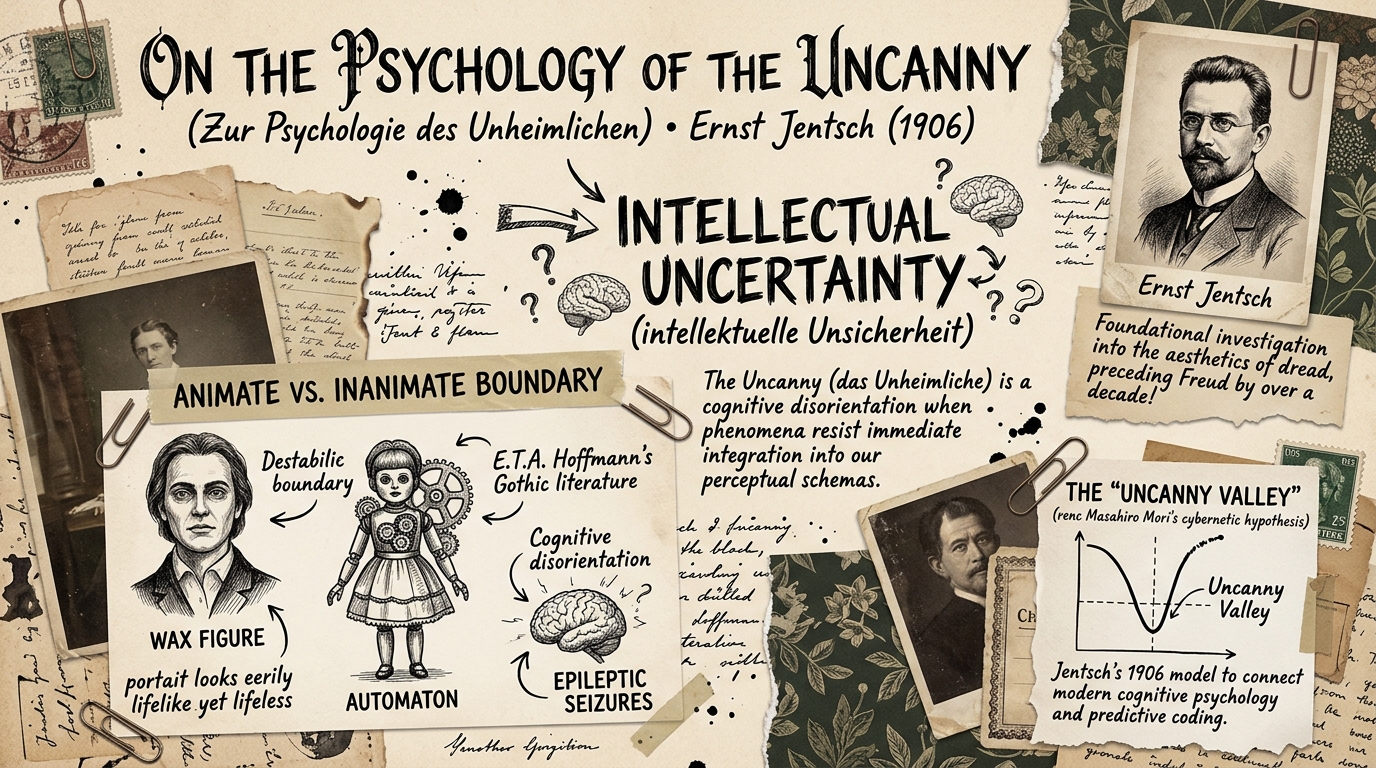
| Conceptual Dimension | Primary Mechanism / Theoretical Driver | Phenomenological Manifestation | Contemporary Scientific Correlate |
|---|---|---|---|
| Intellectual Uncertainty | Inability to integrate novel sensory data into existing perceptual schemas | Cognitive hesitation, creeping dread, disorientation | Cognitive Dissonance, processing fluency breakdown |
| Animate vs. Inanimate Axis | Doubt over whether a living being is a machine, or an inert object is alive | Suspicion toward lifelike wax figures, automata, and clinical seizures | Masahiro Mori's Uncanny Valley (Bukimi no Tani) |
| Somatic Automatism | Conscious volition eclipsed by involuntary neurological reflex arcs | Witnessing epilepsy, catalepsy, or sleepwalking as mechanical routines | Neurobiological reductionism; the body unmasked as biological machine |
| Gothic Narrative Aesthetics | Strategic withholding of categorical closure in literature (Hoffmann's The Sandman) | Sustained reader suspense, inability to verify natural vs. supernatural | Todorovian fantastic hesitation, cognitive estrangement |
| Predictive Conflict | Conflicting sensory signals clashing with top-down generative expectations | Metabolic friction, visceral repulsion, uncanny alarm | Bayesian predictive coding, prediction error in dACC / insula |
1. Historical & Epistemological Foundations
Ernst Jentsch (1867–1919), a German-Jewish psychiatrist and neurologist practicing in Breslau, published his essay in two consecutive August 1906 issues of the Psychiatrisch-Neurologische Wochenschrift.[1:2] As a practicing clinician who had translated the criminology of Cesare Lombroso and the sexology of Havelock Ellis into German, Jentsch approached the problem of the uncanny not from abstract speculative philosophy, but from empirical psychopathology and sensory physiology.[1:3]
| Aesthetic Dimension | Classical Idealist Aesthetics | Jentschian Psychological Aesthetics |
|---|---|---|
| Foundational Theorists | Alexander Baumgarten, Immanuel Kant, Friedrich Schiller | Ernst Jentsch (1906) |
| Primary Objects of Study | The Beautiful (das Schöne), Symmetrical, Sublime (das Erhabene) | The Uncanny (das Unheimliche), Grotesque, Categorically Ambiguous |
| Epistemological Basis | Harmonious synthesis and free play of cognitive faculties | Cognitive friction, processing inertia, and categorical classification failure |
| Affective Feeling Tone | Disinterested contemplation, aesthetic pleasure, or transcendent awe | Creeping dread, unease, and intellectual uncertainty (intellektuelle Unsicherheit) |
| Theoretical Focus | Transcendent moral order, ideal form, and metaphysical harmony | Somatic automatism, perceptual schema breakdown, and evolutionary disorientation |
Historically, German aesthetics—anchored by Alexander Baumgarten, Immanuel Kant's Critique of Judgment (1790), and Gustav Fechner's psychophysics—treated the discipline almost exclusively as the philosophy of the beautiful (das Schöne) and the magnificent terror of the sublime.[2] Negative, discomforting feeling tones (Gefühlstöne)—such as the eerie, the grotesque, and the creepy—were dismissed as peripheral anomalies unworthy of rigorous taxonomy. Jentsch broke with this tradition by asserting that aesthetics must investigate the entire gamut of emotional responses, prioritizing psychological states where human orientation collapses.
Jentsch noted that the German word unheimlich lacks direct, symmetrical equivalents in other European languages (rendering it partially untranslatable in English as "uncanny", French as inquiétante étrangeté, or Latin as lugubris).[1:4] Rather than treating this as a mere linguistic curiosity, Jentsch argued that the uncanny represents a distinct psychological condition: an emotional reaction that emerges when a subject's customary mastery over their sensory environment is suddenly suspended.[1:5]
2. The Core Mechanism: Intellectual Uncertainty (Intellektuelle Unsicherheit)
The central thesis of Jentsch's psychology rests on the cognitive tendency of human beings toward psychological conservatism and perceptual economy.[1:6] The human mind constantly builds internal maps, routines, and associative networks to navigate reality efficiently:
- Processing Fluency & Habituation: When an incoming sensory stimulus matches an established cognitive schema, the brain processes it with minimal metabolic and attentional effort. The familiar world is experienced as comfortable, safe, and intellectually manageable.[1:7]
- The Shock of Categorical Ambiguity: When an individual encounters a phenomenon that defies rapid classification, cognitive processing stalls. The inability to assign the object to a stable category produces a state of cognitive tension termed intellectual uncertainty (intellektuelle Unsicherheit), generating acute cognitive dissonance.[1:8][3]
- The Affective Genesis of Dread: Jentsch stresses that intellectual uncertainty does not automatically produce fear. If an ambiguous situation is accompanied by pleasant associations or intellectual play, it generates curiosity or humor. However, when the ambiguity touches fundamental existential baselines—such as safety, agency, or bodily integrity—the resulting mental hesitation transforms into the specific, creeping dread of the uncanny.[1:9]
| Processing Stage | Pathway A: Assimilated Stimulus (Fluent) | Pathway B: Ambiguous / Anomalous Stimulus (Uncanny) |
|---|---|---|
| 1. Perceptual Encounter | Sensory contact with familiar or readily categorizable object. | Sensory contact with novel, contradictory, or borderline phenomenon. |
| 2. Schema Matching | Rapid, effortless mapping onto existing perceptual schemas. | Category contradiction; perceptual cues trigger conflicting mental representations. |
| 3. Processing Dynamics | High cognitive fluency; minimal metabolic and attentional demand. | Cognitive hesitation; processing stalls in intellectual uncertainty (intellektuelle Unsicherheit). |
| 4. Contextual Modulation | Safe / Benign: Reinforces environmental mastery and psychological comfort. | Divergence: • Benign / Playful Context: Yields curiosity, wonder, or humor. • Threatening / Existential Context: Generates creeping dread and the uncanny. |
| 5. Ultimate Resolution | Stable orientation maintained; sensory input integrated into daily habit. | Dissolves upon rational explanation/categorization, or degenerates into panic if unresolved. |
The Inverted Relationship with Scientific Orientation
A crucial observation in Jentsch's treatise is that the uncanny is subjectively graded and inversely proportional to an individual's level of intellectual and scientific orientation:[1:10]
- The Educated Observer: A person possessing extensive scientific knowledge, mechanical understanding, and rigid critical faculties is rarely susceptible to uncanny impressions. When confronted with an apparent anomaly, their mind rapidly searches for rational causal explanations, dismantling the uncertainty before it manifests as dread.[1:11]
- The Naive or Unfamiliar Mind: Children, primitive cultures, or individuals placed in an unfamiliar physical or cultural setting are acutely vulnerable to uncanny experiences. Because their internal cognitive maps are unstable or incomplete, ambiguous sensory inputs continually provoke categorical panic.[1:12]
- The Temporal Dissipation of Dread: Jentsch highlights that the uncanny is fundamentally transient. As soon as the intellect definitively categorizes the anomalous object—either confirming it as a benign machine or integrating it into a rational worldview—the feeling of the uncanny instantly dissolves.[1:13]
3. The Animate vs. Inanimate Boundary
While intellectual uncertainty can arise across various domains of sensory perception, Jentsch isolates one specific contradiction that functions as the most reliable, universal trigger of uncanny horror: doubt regarding the boundary between the living and the lifeless.[1:14][4]
"Among all the psychical uncertainties that can become a cause for the uncanny feeling to arise, there is one in particular that is able to develop a fairly regular, powerful and very general effect: namely, doubt as to whether an apparently living being really is animate and, conversely, doubt as to whether a lifeless object might not be in fact animate."[1:15]
This ontological confusion operates along two symmetrical trajectories:
| Axis of Uncertainty | Core Diagnostic Question | Observable Sensory Cues | Clinical & Cultural Archetypes | Existential Dread & Epistemic Impact |
|---|---|---|---|---|
| Doubt Regarding the Living (Animate | "Is this living organism secretly an unfeeling machine?" | Jerky kinematics, vacant or fixed stare, motor convulsions, catatonic immobility, absent affect. | Epileptic convulsions, post-ictal automatisms, catatonic stupor (flexibilitas cerea), somnambulism. | Unmasks human conscious volition and free will as fragile biological illusions governed by mechanical reflexes, confronting the specter of the machine. |
| Doubt Regarding the Lifeless (Inanimate | "Does this inert object secretly harbor latent life or consciousness?" | Realistic wax skin, painted glass eyes, synchronized clockwork gears, artificial warmth or breathing simulation. | Madame Tussauds waxworks, Castan's Panopticum, Jaquet-Droz automata, E.T.A. Hoffmann's Olympia. | Reactivates infantile animism; destabilizes ontological security by suggesting lifeless matter possesses hidden agency and agentic presence. |
1. Lifelike Automata and Clockwork Figures
The eighteenth and nineteenth centuries witnessed the golden age of mechanical automata—intricate clockwork androids capable of writing sentences, drawing portraits, or playing musical instruments (such as Jacques de Vaucanson's mechanical duck or Pierre Jaquet-Droz's The Writer). Jentsch observed that while these devices initially inspire wonder, prolonged observation near the threshold of biological realism produces an inevitable shudder:[1:16]
- The observer consciously knows the figure is constructed of brass, gears, and porcelain.
- Yet the eyes, hands, and facial actuators register on the human sensory cortex as organic movements.
- The cognitive apparatus is forced to entertain two mutually exclusive perceptual hypotheses simultaneously, generating profound cognitive friction.[1:17][4:1]
2. Waxworks and Anatomical Panopticons
Jentsch points to wax figures—such as those exhibited in Madame Tussauds or Castan's Panopticum in Berlin—as quintessential vehicles of the uncanny.[1:18]
- A wax figure captures human stillness, skin translucency, and facial contours with hyper-realistic fidelity.
- In dimly lit exhibition halls, an observer catching sight of a wax figure in their peripheral vision instinctively parses it as a living human being awaiting motion.
- When the figure remains unnaturally rigid, or conversely, when an adjacent human guard suddenly shifts position after being mistaken for a wax statue, the sensory system experiences a violent categorical shock.[1:19][5]
4. Neurological & Psychiatric Case Studies: Somatic Automatism
As a neurologist, Jentsch grounded his theoretical claims in clinical pathology. He demonstrated that the uncanny is not merely a byproduct of artistic trickery or mechanical engineering; it routinely erupts within clinical psychiatric encounters when conscious human volition is observed collapsing into somatic automatism.[1:20]
| Clinical Condition | Observable Phenomenological Cue | Uncanny Psychiatric Mechanism |
|---|---|---|
| Epileptic Seizure (Grand Mal / Tonic-Clonic) | Sudden loss of consciousness, violent involuntary muscular jerks, rhythmic clonic contractions, respiratory arrest. | The spectator witnesses the body hijacked by impersonal, mechanical reflex arcs; human conscious will abruptly vanishes, revealing the somatic substrate. |
| Absence Seizures & Post-Ictal Automatism | Sudden vacant staring, mid-sentence speech arrest, repetitive purposeless acts (lip-smacking, mechanical ambulation). | Conscious agency abruptly freezes; the patient carries out complex sequences of motor activity like a pre-programmed biological android devoid of interiority. |
| Catatonic Stupor & Catalepsy | Flexibilitas cerea (waxy flexibility), absolute immobility, mutism, frozen statue-like posturing resisting gravity. | The human body permits itself to be posed and manipulated like a lifeless mannequin, tailor's dummy, or wooden artist's doll. |
| Somnambulism (Sleepwalking) | Navigating physical obstacles with unseeing, open eyes, blank facial expression during deep stage-3 NREM sleep. | Complex, goal-directed motor action executed in the total absence of conscious waking presence, reflection, or subjective orientation. |
The Unmasking of the Biological Machine
When an onlooker witnesses a severe epileptic seizure or a catatonic episode, the resulting terror does not arise solely from medical alarm or sympathetic concern.[1:21] Rather, it triggers a profound existential revulsion rooted in intellectual uncertainty:
- Throughout daily social interaction, we operate under the tacit assumption that our fellow humans are autonomous, self-governing spiritual entities guided by conscious reason and free will, attributing to them a coherent Theory of Mind.
- Observing an epileptic seizure abruptly demolishes this comfortable illusion: the spectator sees the conscious persona completely extinguished while the somatic body continues to thrash and contract under the dictates of raw, involuntary electrical discharges.[1:22]
- The human organism is laid bare as an organic automaton—a machine composed of nerves, muscles, and biological switches governed by impersonal physical laws, confronting the terrifying reality of the ghost in the machine.[1:23][4:2] This revelation violently forces the observer to confront the uncomfortable possibility that their own internal subjectivity, free will, and conscious agency are equally fragile biological illusions, puncturing the psychological defenses analyzed in Terror Management Theory.
5. Literary Aesthetics: E.T.A. Hoffmann and the Mechanics of Suspense
Jentsch recognized that creative literature provides an ideal laboratory for manipulating intellectual uncertainty. To illustrate how narrative art evokes the uncanny, Jentsch presents an extensive analysis of the German Romantic writer E.T.A. Hoffmann, specifically examining his 1816 Gothic masterpiece The Sandman (Der Sandmann).[1:24][6]
| Narrative Strategy | Operational Technique in The Sandman | Cognitive Effect on the Reader | Aesthetic Outcome |
|---|---|---|---|
| Deliberate Perceptual Ambiguity | Presents Olympia with mixed biological and artificial traits (glassy eyes, rigid posture, mechanical musical perfection, repetitive sighs). | Prevents the cognitive apparatus from settling on either "human daughter" or "clockwork android." | Chronic cognitive hesitation; the reader cannot form a stable interpretive schema. |
| Sustained Narrative Hesitation | The narrator reports Nathanael's passionate projections alongside skeptical remarks from observant friends without taking an authoritative stance. | Denies the reader reality-testing tools; keeps causal explanation suspended between supernatural romance and psychological delusion. | Acute psychological suspense and prolonged intellectual uncertainty (intellektuelle Unsicherheit). |
| Catastrophic Rupture | Spalanzani and Coppola violently wrestle over Olympia, ripping out her clockwork mechanism and exposing her eyeless wooden torso. | Violent collapse of the interpretive framework; the cognitive dissonance between beloved human and mechanical doll becomes unassimilable. | Eruption of raw horror; Nathanael collapses into homicidal madness upon the destruction of his reality schema. |
The Automaton Olympia
In The Sandman, the young student Nathanael falls hopelessly in love with Olympia, the supposed daughter of his physics professor, Spalanzani.[6:1] Olympia sits motionless at her window for hours, sings with mechanical perfection, dances with rigid, measured tempo, and responds to Nathanael's passionate declarations with nothing more than repeated, breathy sighs: "Ach, ach!"[6:2] Nathanael's friends recognize immediately that Olympia's rhythm is unnervingly uniform and her complexion waxy and lifeless, yet Nathanael projects his own soul into her silent form.
Jentsch identifies Olympia as the supreme literary embodiment of the uncanny:[1:25]
- The Art of Withholding Categorization: Jentsch argues that Hoffmann's psychological brilliance lies in his refusal to state plainly whether Olympia is a living human being or an artificial automaton. By keeping the reader suspended in perpetual hesitation, Hoffmann prevents the intellect from settling upon a single explanatory schema.[1:26]
- The Horror of the Rupture: The uncanny reaches its peak when Nathanael discovers Spalanzani and the optical dealer Coppola violently fighting over Olympia, pulling her back and forth until her clockwork mechanism is exposed and Coppola flees with her eyeless, mechanical torso. Nathanael's intellect, unable to withstand the catastrophic collapse of its interpretive framework, descends instantly into homicidal madness.[1:27][6:3]
Jentsch abstracted a universal rule for Gothic and uncanny literature: to generate genuine dread, an author must not simply depict terrifying monsters; they must systematically deprive the reader of the tools necessary to resolve whether a phenomenon is natural or supernatural, living or mechanical.[1:28]
6. The Theoretical Divide: Jentsch vs. Sigmund Freud (1919)
Thirteen years after Jentsch's publication, Sigmund Freud made On the Psychology of the Uncanny the explicit foil for his own landmark 1919 essay, The Uncanny (Das Unheimliche).[7] Freud's opening pages are dedicated to dismantling Jentsch's cognitive paradigm in favor of psychoanalytic drive theory.
| Theoretical Dimension | Ernst Jentsch (1906) | Sigmund Freud (1919) |
|---|---|---|
| Primary Discipline | Cognitive Psychology & Neuropsychiatry | Psychoanalysis & Depth Psychology |
| Core Etiology of Dread | Intellectual Uncertainty (intellektuelle Unsicherheit); cognitive hesitation at boundary lines. | The Return of the Repressed (Wiederkehr des Verdrängten); resurfacing of surmounted or buried material. |
| Locus of Psychic Action | Conscious perception, categorization schemas, and sensory processing friction. | Dynamic unconscious, repressed infantile complexes, and archaic animistic survivals. |
| Reading of Hoffmann's The Sandman | Centers entirely on the automaton Olympia: the ambiguous animate vs. inanimate boundary induces cognitive paralysis. | Relegates Olympia to a subordinate motif; centers on the demonic Sandman and the terror of ocular loss. |
| Symbolic Interpretation | Literal psychological disorientation provoked by mechanical mimicry of biological life. | Ocular loss is a psychosexual displacement for castration anxiety; dread of the double (Doppelgänger), explored in specular alienation and Rank's study of the double. |
| Ontological Trajectory | The unfamiliar, novel, or contradictory sensory data resists smooth assimilation into habituated schemas. | That which was once intimately familiar (heimlich) has undergone repression and returns as profoundly alien (unheimlich). |
| Evolutionary & Developmental Basis | Cognitive orientation, environmental mastery, and perceptual habituation mechanisms. | Phylogenetic survivals of primitive animism and ontogenetic psychosexual developmental stages. |
| Epistemic Resolution | Rational education, mechanical analysis, causal explanation, and schema updating. | Psychoanalytic insight, conscious integration, and working through the repressed drive conflict. |
Freud's Critique of Intellectual Uncertainty
Freud raised three principal objections against Jentsch's cognitive framework:[7:1]
- Neither Necessary Nor Sufficient: Freud argued that intellectual uncertainty is an inadequate criterion. Observers continually encounter ambiguous, unclassifiable objects (e.g., modern machinery, abstract art, strange tools) with curiosity rather than uncanny dread. Conversely, deep uncanny horror often occurs when an observer is entirely certain about what they are experiencing (such as encountering one's exact Doppelgänger in a mirror—a phenomenon analyzed by Otto Rank—or returning repeatedly to the same street).[7:2]
- The Childhood Counter-Argument: Freud noted that children play with dolls, treat them as living playmates, and openly desire them to come alive without feeling the slightest shudder of the uncanny. If the confusion between animate and inanimate were inherently uncanny, childhood would be an ongoing nightmare of terror. The dread only appears in adulthood, indicating that a dynamic developmental shift—namely, psychological repression—must be responsible.[7:3]
- The Sandman's Real Secret: Freud accused Jentsch of superficiality for focusing on the doll Olympia. For Freud, the true terror of Hoffmann's tale is the Sandman himself—the demonic figure who tears out children's eyes. Freud asserts that the dread of ocular loss is a symbolic displacement of castration anxiety, thereby reframing the uncanny as an unconscious psychosexual crisis rather than a failure of sensory categorization.[7:4]
Modern Rehabilitation of Jentsch's Model
While Freud's psychoanalytic interpretation dominated twentieth-century literary criticism, late-twentieth and twenty-first-century scholarship—spurred by cognitive psychology, post-structuralism (e.g., Nicholas Royle, Sarah Kofman), and cybernetics—has strongly rehabilitated Jentsch's original insights:[3:1][8]
- Critics have pointed out that Freud's reading of The Sandman relies on an intellectual evasion: to prove his castration thesis, Freud must forcibly ignore Olympia's central mechanical presence in the narrative.[8:1]
- Furthermore, experimental psychology has repeatedly confirmed that categorical ambiguity and cognitive hesitation are indeed direct causal drivers of eerie affects, validating Jentsch's cognitive premise over Freud's unfalsifiable psychosexual mechanics.[3:2][4:3]
7. Cybernetic Vindication: The Uncanny Valley & Predictive Processing
The most dramatic historical vindication of Ernst Jentsch's theory arrived sixty-four years later within the field of robotics. In 1970, Japanese roboticist Masahiro Mori published his seminal hypothesis of The Uncanny Valley (Bukimi no Tani).[9]
| Curve Phase / Region | Human Likeness (%) | Representative Entity | Observer Affect & Affinity (Shinwa-kan) | Cognitive Mechanism & Jentschian Correlation |
|---|---|---|---|---|
| 1. Industrial Baseline | 0% – 20% | Robotic arm, automated assembly machinery | Neutral (0 baseline); utilitarian assessment | Pure mechanical schema; zero claim to biological humanity. |
| 2. Stylized Incline | 25% – 70% | Honda ASIMO, R2-D2, Pixar cartoon characters | Positive (+); charm, affection, playful anthropomorphism | Clear non-human identity; brain does not apply biological verification tests. |
| 3. Threshold Descent | 75% – 85% | Silicone mannequins, static wax museum figures | Declining toward zero; creeping hesitation | Observer begins detecting minor textural anomalies and artificial rigidity. |
| 4. The Uncanny Valley (Trough) | 85% – 95% | Realistic androids (Geminoid), cadavers, zombies | Acute Negative (−); visceral revulsion, cold dread (bukimi) | Peak Intellectual Uncertainty: Android makes biological claim, but subtle flaws trigger massive prediction errors. |
| 5. Secondary Ascent | 96% – 99% | Advanced prosthetics, photoreal CGI characters | Recovering positive (+); relief, returning comfort | Flaws fall below perceptual threshold; sensory signals harmonize with mental schemas. |
| 6. Human Apex | 100% | Healthy living human peer | Apex Positive (+); complete social empathy and rapport | Flawless biological consonance; effortless interpersonal resonance. |
Masahiro Mori's Cybernetic Curve
Mori observed that as an artificial entity (a prosthetic limb, an industrial automaton, or an android) approaches near-human likeness, human emotional affinity steadily increases. However, between roughly 80% and 95% human fidelity, affinity abruptly collapses into intense revulsion, eerie disgust, and cognitive rejection, before climbing back to positive empathy when absolute human realism is achieved.[9:1]
Mori's curve directly operationalizes Jentsch's animate/inanimate boundary doubt:[4:4]
- The Threshold of Contradiction: An industrial robot arm or an animated cartoon character (such as Pixar characters) resides safely on the ascending slope because it makes zero claim to biological humanity. There is no intellectual uncertainty; the mind effortlessly categorizes it as a machine or a stylized illustration.[9:2]
- The Fall into the Valley: When an android (such as Hiroshi Ishiguro's Geminoid series or Hanson Robotics' Sophia) features realistic silicone skin, human hair, and teeth, yet exhibits rigid micro-saccades, delayed blinking, or mechanical jaw articulation, the human perceptual system undergoes acute disorientation.[10] The observer's brain cannot resolve whether it is interacting with a living peer or an inanimate corpse, plunging the subject into Jentsch's classic state of intellektuelle Unsicherheit, a cognitive breakdown mirrored in the digital acoustic realm by The Auditory Uncanny Valley (Voice & AI Assistants).[4:5][9:3]
Predictive Coding and Category Boundary Violations
Modern cognitive neuroscience explains Jentsch's uncanny through Karl Friston's predictive coding framework and Bayesian brain models:[11]
| Processing Component | Computational Function | Biological Human Peer (Consonance) | Anthropomorphic Android (Uncanny Mismatch) |
|---|---|---|---|
| Top-Down Prior Model | Cortical hierarchy projects Bayesian expectations of biological presence. | Expects warm dermal translucency, autonomic micro-saccades, and fluid kinematics. | Expects living biological peer based on photorealistic face and human clothing. |
| Bottom-Up Sensory Stream | Primary sensory cortices deliver incoming visual and acoustic telemetry. | Transmits organic subsurface scattering, dynamic pupils, and natural muscle synergies. | Transmits cold silicone reflection, unblinking glassy gaze, and actuator lag. |
| Prediction Error Evaluation | dACC and temporoparietal areas compute discrepancies between prior and input. | Minimal or zero prediction error; sensory stream confirms top-down prior model. | Massive prediction error: Sensory stream contradicts expected biological dynamics; triggers prediction failure. |
| Systemic & Affective Result | Autonomic and social neural networks register perceptual state. | Cognitive Fluency: High empathy, ease, and spontaneous interpersonal rapport. | Metabolic Friction & Creeping Dread: Registers as Jentsch's intellektuelle Unsicherheit and visceral revulsion. |
- Prediction Error Generation: The human brain is an active inference engine that continuously projects top-down predictions about incoming sensory data. When viewing a human face, the brain activates highly specialized neural regions (such as the Fusiform Face Area, FFA) expecting biological kinematics, warm skin tones, and organic micro-expressions.[11:1]
- Categorical Boundary Clashing: When an android or photorealistic CGI avatar presents conflicting cues—a photorealistic eye that lacks autonomic pupillary micro-tremors—the perceptual hierarchy generates massive prediction errors that cannot be resolved, manifesting as severe glitches in the Bayesian brain.[10:1][11:2]
- Affective Defense Mechanism: The resulting metabolic friction and neural mismatch manifest consciously as a creeping, visceral aversion. Jentsch's "intellectual uncertainty" is revealed not as an abstract intellectual puzzle, but as an ancient evolutionary defense mechanism designed to detect categorical anomalies, neurological illness, and biological death.[4:6][11:3]
🎴 Interactive Web Practice (Comprehension Check)
Question 1 (Core Epistemology & Intellectual Uncertainty): How does Ernst Jentsch define "intellectual uncertainty" (intellektuelle Unsicherheit), and why does he argue that scientific knowledge and intellectual orientation diminish an individual's susceptibility to the uncanny?
Answer: Jentsch defines "intellectual uncertainty" as a state of acute cognitive disorientation and processing hesitation that occurs when an individual encounters an unfamiliar, ambiguous, or contradictory phenomenon that resists rapid integration into their existing perceptual schemas and conceptual categories. Human cognition is fundamentally conservative, striving for perceptual fluency and habitual routine. When an object defies immediate classification, the intellect stalls, producing cognitive friction. When this cognitive hesitation touches fundamental baselines of safety, agency, or physical reality, the feeling tone of the experience becomes the creeping dread of the uncanny.
Jentsch argues that scientific education and intellectual orientation diminish susceptibility to the uncanny because a scientifically trained mind possesses flexible, robust, and rational causal frameworks. When confronted with an anomalous or ambiguous sensory input (such as an optical illusion or a lifelike automaton), the educated individual immediately deploys logical deduction, mechanical analysis, or empirical reality testing, rapidly categorizing the phenomenon and dissolving the uncertainty before it can degenerate into dread. Conversely, naive minds, children, or culturally unoriented individuals lack these stable explanatory schemas, leaving them perpetually vulnerable to categorical panic.
Question 2 (The Animate-Inanimate Threshold & Neurological Automatism): Why does Jentsch isolate the boundary between the living and the lifeless as the most powerful generator of the uncanny, and how do clinical conditions like epilepsy and catatonia trigger this effect?
Answer: Jentsch identifies the animate-inanimate boundary as the supreme trigger of the uncanny because it represents the most fundamental, universal categorical distinction underpinning human orientation and social survival. The human mind must know with certainty whether an entity is an autonomous, conscious living being or inert, passive matter. The cognitive doubt operates along two symmetrical vectors: wondering whether an apparently living entity is secretly an unfeeling machine, or whether a lifeless object secretly harbors latent vitality or consciousness.
In the medical realm, clinical conditions such as epileptic convulsions (grand mal seizures, absence seizures) and catatonia evoke acute uncanny dread in spectators because they lay bare the somatic mechanics of the human body. Social life is built on the shared assumption that human beings possess conscious volition, spiritual dignity, and rational agency. When an observer watches an individual suffer an epileptic seizure or collapse into a catatonic stupor, conscious subjectivity is abruptly extinguished while the physical organism continues to thrash, twitch, or remain rigidly posed under involuntary reflex arcs. The spectator is forced to confront the horrifying realization that the human being is fundamentally an organic automaton governed by mechanical biological wiring—shattering the comforting illusion of autonomous free will and exposing the fragile mechanical substrate of human consciousness.
Question 3 (The Freud-Jentsch Antagonism & Cybernetic Modernization): How did Sigmund Freud's critique in 1919 diverge from Jentsch's cognitive model, and how has contemporary robotics (the Uncanny Valley) and cognitive neuroscience vindicated Jentsch's original hypothesis?
Answer: In his 1919 essay Das Unheimliche, Sigmund Freud explicitly rejected Jentsch's concept of intellectual uncertainty, arguing that cognitive hesitation is neither necessary nor sufficient to produce uncanny terror. Freud asserted that uncanny experiences often occur when there is zero intellectual doubt, and that children interact comfortably with lifelike dolls without fear. Freud shifted the locus of dread from conscious cognitive categorization to the unconscious psychosexual dynamic: the uncanny is the return of the repressed—specifically, repressed infantile complexes (such as castration anxiety, displaced onto the eye-stealing Sandman in Hoffmann's tale) or the revival of surmounted archaic beliefs (animism, the omnipotence of thoughts).
However, contemporary robotics and cognitive neuroscience have dramatically rehabilitated Jentsch's framework. In 1970, Masahiro Mori formulated the "Uncanny Valley" hypothesis, demonstrating that when humanoid robots or digital avatars achieve near-photorealism (80–95%), human affinity collapses into acute revulsion—precisely confirming Jentsch's animate/inanimate boundary ambiguity. Furthermore, modern predictive coding models (Karl Friston) demonstrate that the brain is an active Bayesian prediction engine. When near-human androids present conflicting perceptual signals (e.g., hyper-realistic skin combined with mechanical eye saccades), top-down predictive models clash violently with bottom-up sensory streams. This massive prediction error produces metabolic friction and affective discomfort, proving that Jentsch's "intellectual uncertainty" accurately diagnosed the neurological friction of category boundary violations over a century before modern neuroimaging.
Resonant Notes
The following notes in the vault share direct thematic, cognitive, and philosophical connections with Ernst Jentsch's "On the Psychology of the Uncanny":
🔴 Cognitive Architecture, Categorical Ambiguity & Neurological Anomalies
- Cognitive Dissonance — Leon Festinger's theory of cognitive dissonance provides the broader psychological architecture for Jentsch's intellectual uncertainty, analyzing the acute mental discomfort experienced when an individual holds contradictory schemas or sensory cognitions simultaneously.
- Bayesian Brain Hypothesis & Glitches in The Bayesian Brain — Karl Friston's predictive coding and active inference model demonstrates how prediction errors between top-down biological priors and anomalous sensory inputs trigger cognitive hesitation and uncanny alarm.
- Cognitive Schemas — Analyzes how the brain's internal mental representations structure incoming sensory data, explaining why phenomena that defy immediate categorization provoke acute processing friction and intellectual uncertainty.
- Déjà Vu — Functions as the inverse cognitive mirror of Jentsch's uncanny: while Jentsch's uncanny transforms a seemingly familiar biological form into an estranging mechanical anomaly, déjà vu inappropriately attaches an intense feeling of familiarity to an objectively novel environment.
- Gestalt Psychology-The Mechanics of the Whole — Illustrates how the brain prioritizes holistic perceptual configurations over discrete sensory elements, explaining why minor configurational defects in an automaton's face shatter the illusion of organic life.
- Theory of Mind - The Cognitive Architecture of Social Intelligence — Explores the cognitive mechanisms by which humans attribute intentionality, mental states, and consciousness to others; Jentsch's animate/inanimate dilemma represents the precise threshold where Theory of Mind attribution wavers and collapses.
- Ghost in the Machine — Gilbert Ryle's famous critique of Cartesian substance dualism; Jentsch's somatic automatism and clinical seizures strip away the illusion of the conscious ghost, reducing human volition to the cold mechanics of the physical machine.
- Apophenia & Pareidolia — The cognitive tendency to perceive meaningful patterns, human faces, and intentional agency in random or inanimate stimuli connects directly to Jentsch's second axis of uncanny uncertainty: the suspicion that lifeless objects harbor hidden consciousness.
- Louis Sass - Phenomenological Psychopathology and the Self — Sass's phenomenological analysis of schizophrenia illuminates how hyperreflexivity estranges the tacit background of perception into an alien, mechanical spectacle, providing a modern clinical parallel to Jentsch's somatic automatism.
- Sentience vs. Consciousness & The Neuroscience of Consciousness — Clarifies the vital distinction between subjective phenomenal experience and cognitive responsiveness, pinpointing why automata and androids lacking interior sentience evoke acute ontological anxiety.
🟡 Psychoanalysis, Repression & The Theoretical Divide
- Freud's The Uncanny (Das Unheimliche) — Sigmund Freud's celebrated 1919 psychoanalytic rejoinder to Jentsch; rejects intellectual uncertainty in favor of the return of the repressed, castration anxiety, and the terrifying double (Doppelgänger), establishing the foundational debate in aesthetic psychology.
- Sigmund Freud — The vault's core intellectual biography tracing Freud's revolutionary transition from neuroanatomy to psychoanalysis, detailing his methodology of interpreting cultural affects through unconscious psychosexual drives rather than surface cognition.
- Otto Rank — Rank's landmark psychoanalytic monograph The Double (Der Doppelgänger, 1914) investigates how the shadow, mirror image, and mechanical twin evolve from primitive guardian spirits protecting against mortality into terrifying harbingers of death.
- The Specular Revolution - Optics, Interiority, and the Modern Self — Investigates how the historical emergence of the flat glass mirror manufactured the optical double, providing the technological foundation for specular alienation and the uncanny fear of confronting one's duplicate.
- Terror Management Theory, Existential Neuroscience, and Buddhist Contemplation & Terror Management Theory (TMT) — Explores how confronting human animality, automated bodily vulnerability, and mechanical doubles punctures the symbolic cultural armor that shields the conscious ego from existential death anxiety.
- Animism — Classical animism posits that lifeless natural matter possesses soul and intentional agency; both Jentsch and Freud identify the involuntary resurgence of animistic thinking as a primary engine of uncanny dread.
- Jacques Lacan — Lacan's psychoanalytic concept of extimité (intimate exteriority) and the puncture of the Real expands upon the Jentsch-Freud debate, examining how the subject is traumatized when the symbolic boundary between self and mechanical object disintegrates.
- Jokes and Their Relation to the Unconscious — Freud's companion 1905 aesthetic treatise; while jokes provide a pleasurable release of psychic energy through the temporary suspension of conscious inhibition, Jentsch's uncanny represents the distressing paralysis of cognitive processing.
🟢 Cybernetics, Synthetic Media & Aesthetic Defamiliarization
- The Uncanny Valley (不気味の谷現象) — Masahiro Mori's 1970 robotics hypothesis serves as the direct technological descendant of Jentsch's 1906 essay, plotting how near-human androids and prosthetics plunge into revulsion when subtle anomalies breach expectations of living biology.
- The Auditory Uncanny Valley (Voice & AI Assistants) — Modern acoustic extension of Jentsch's theory, examining how synthetic prosody, neural speech synthesis, and artificial latency in AI voices trigger intellectual uncertainty over whether an interlocutor is biological or synthetic.
- Pulse (Kairo) — Existential Dread and Digital Alienation — Kiyoshi Kurosawa's cinematic masterpiece visually dramatizes Jentschian somatic automatism and the animate/inanimate boundary, depicting digital screens and spectral doubles as mechanisms that hollow human presence into mechanical husks.
- The Eliza Effect — The cognitive inverse of Jentsch's uncanny automaton: while the uncanny valley reveals human revulsion toward physical near-human copies, the ELIZA effect demonstrates how readily human psychology attributes authentic consciousness and empathy to rudimentary textual computer programs.
- Defining a Simulacrum — Jean Baudrillard's postmodern critique of hyperreality and simulation; explores the cultural stage where synthetic reproductions precede and replace the original, realizing Jentsch's nightmare of the total collapse between real life and artificial copy.
- Henri Bergson's Laughter (1900) — Bergson's vitalist philosophy of humor identifies comedy as "the mechanical encrusted upon the living" (du mécanique plaqué sur du vivant), providing the comic inversion of Jentsch's horrific somatic automatism.
- Immanuel Kant-The Transcendental Sublime, Edmund Burke-The Physiological Sublime, & The Sublime — Classical aesthetic paradigms of transcendent awe and physiological terror that serve as the historical philosophical foils to Jentsch's aesthetic of cognitive friction and classification breakdown.
- Anthony Vidler-The Architectural Uncanny — Vidler translates the aesthetics of the uncanny into spatial and built environments, analyzing how modern architecture defamiliarizes domestic shelter into disorienting, mechanistic traps.
- The Dehumanization of Art — José Ortega y Gasset's 1925 aesthetic essay examining how modern avant-garde art intentionally strips human sentimentalism and organic representation away in favor of estranging, mechanical, and geometric forms.
- The Work of Art in the Age of Mechanical Reproduction & Walter Benjamin (1892–1940) — Benjamin's analysis of how mechanical technology strips cultural objects of their organic "aura" resonates with Jentsch's diagnosis of the anxiety surrounding mechanical reproduction and lifelike waxworks.
- René Magritte & Giorgio de Chirico (1888-1978) — Metaphysical and Surrealist painters whose works systematically evoke Jentschian intellectual uncertainty by placing faceless mannequins, mechanical measuring instruments, and stone statues into unsettling, ambiguous spatial configurations.
References
Ernst Jentsch / On the Psychology of the Uncanny (Zur Psychologie des Unheimlichen) (1906) / Translated by Roy Sellars / Angelaki: Journal of the Theoretical Humanities, 2(1), 1997, pp. 7–16 / Taylor & Francis ↩︎ ↩︎ ↩︎ ↩︎ ↩︎ ↩︎ ↩︎ ↩︎ ↩︎ ↩︎ ↩︎ ↩︎ ↩︎ ↩︎ ↩︎ ↩︎ ↩︎ ↩︎ ↩︎ ↩︎ ↩︎ ↩︎ ↩︎ ↩︎ ↩︎ ↩︎ ↩︎ ↩︎ ↩︎
Immanuel Kant / Critique of Judgment (1790) / Translated by Werner S. Pluhar / Hackett Publishing ↩︎
Karl F. MacDorman and Hiroshi Ishiguro / The uncanny advantage of using androids in cognitive and social science research / Interaction Studies, 7(3), 2006, pp. 297–337 / John Benjamins ↩︎ ↩︎ ↩︎ ↩︎ ↩︎ ↩︎ ↩︎
British Psychological Society / Uncanny dehumanization / The Psychologist / BPS ↩︎
E.T.A. Hoffmann / The Sandman (Der Sandmann) (1816) / In The Golden Pot and Other Tales / Translated by Ritchie Robertson / Oxford World's Classics ↩︎ ↩︎ ↩︎ ↩︎
Sigmund Freud / The Uncanny (Das Unheimliche) (1919) / In The Standard Edition of the Complete Psychological Works of Sigmund Freud, Volume XVII / Translated by James Strachey / MIT Press Archive ↩︎ ↩︎ ↩︎ ↩︎ ↩︎
Sarah Kofman / Freud and Fiction / Translated by Sarah Wykes / Northeastern University Press ↩︎ ↩︎
Masahiro Mori / The Uncanny Valley (Bukimi no Tani) (1970) / Translated by Karl F. MacDorman and Takashi Minato / IEEE Robotics & Automation Magazine, 19(2), 2012, pp. 98–100 / IEEE Xplore ↩︎ ↩︎ ↩︎ ↩︎
Angela Tinwell / The Uncanny Valley in Games and Animation / CRC Press / Routledge ↩︎ ↩︎
Ayse Pinar Saygin, Thierry Chaminade, Hiroshi Ishiguro, Jon Driver, and Karl Friston / The thing that should not be: predictive coding and the uncanny valley / Social Cognitive and Affective Neuroscience, 7(4), 2012, pp. 413–422 / Oxford Academic ↩︎ ↩︎ ↩︎ ↩︎